

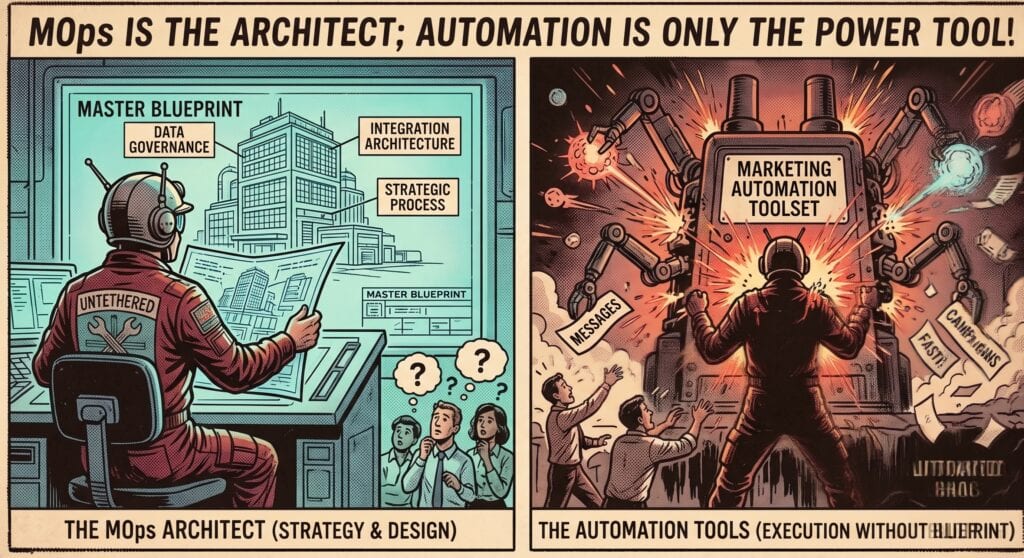
Marketing Operations (MOps) is the end-to-end management of people, processes, and technology that enables a marketing organization to function efficiently and scale effectively. While often confused with the tools it manages, Marketing Operations is the strategic architecture that ensures marketing activities drive measurable business growth. In 2026, it serves as the critical “operating system” that translates high-level strategy into executable, data-driven workflows.
According to recent industry data, companies with high-maturity Marketing Operations functions see a 15-20% increase in marketing productivity and a 10% growth in lead-to-revenue conversion rates [1]. Research from 2026 indicates that 85% of high-performing marketing departments now treat MOps as a distinct leadership discipline rather than a subset of IT or general marketing [2]. This shift reflects the growing complexity of the modern MarTech stack and the need for specialized oversight.
The importance of Marketing Operations lies in its ability to create “Executive-Grade Clarity” out of operational chaos. At Untethered Office, we observe that marketing leaders are often buried in manual work and unable to prove ROI because they lack a functional operating system. By establishing a robust MOps framework, organizations can finally stop “bolting on” AI and instead build an AI-ready foundation that works this quarter without adding unnecessary headcount.
What are the key characteristics of Marketing Operations?
- Strategic Process Design: Creating the standard operating procedures that govern how work moves from an idea to a finished campaign.
- Data Governance and Analytics: Ensuring data integrity across the entire funnel to provide a single source of truth for executive reporting.
- MarTech Stack Management: Selecting, integrating, and optimizing the suite of tools used by the marketing team to prevent technical debt.
- Financial Management: Budget tracking and performance attribution to ensure every marketing dollar is accounted for and optimized.
- Operational Agility: Building the capacity to pivot strategies quickly based on real-time performance data and market shifts.
How Does Marketing Operations Work?
The Marketing Operations function operates through a continuous cycle of planning, execution, and optimization. It begins with Strategic Alignment, where MOps leaders work with stakeholders to define the KPIs and reporting structures required to measure success. This ensures that the technical infrastructure is built to answer the specific questions the CEO and CFO will ask about revenue and ROI.
Once the strategy is set, the focus shifts to Infrastructure and Integration. This involves connecting disparate tools—such as CRMs, email platforms, and AI assistants—into a unified ecosystem. Untethered Office advocates for an “Ops-First, AI-Second™” approach, which prioritizes setting up these clean workflows before introducing complex automation. This prevents the common pitfall of automating a broken process, which only leads to faster failure.
The final phase is Measurement and Iteration. Marketing Operations professionals monitor the “Clarity Loops” to identify bottlenecks in the lead lifecycle or inefficiencies in campaign spend. By analyzing these outputs, MOps can recommend specific process changes or tool adjustments. This creates a scalable leverage point where the marketing team can produce more results without a proportional increase in effort or manual labor.
Common Misconceptions About Marketing Operations
There is often significant confusion regarding what MOps actually entails versus what it is perceived to be. Addressing these myths is essential for leaders looking to gain control over their departments.
| Myth | Reality |
|---|---|
| MOps is just “the person who runs the software.” | MOps is a strategic role that manages the entire lifecycle of marketing efficiency, not just tool administration. |
| You only need MOps if you have a massive team. | Small teams often need MOps more to create the leverage required to compete with larger organizations. |
| Automation and MOps are the same thing. | Automation is a tool used by MOps; MOps is the strategy that determines how and why to automate. |
| Adding more tools solves operational problems. | Adding tools to a broken process creates “MarTech bloat”; MOps simplifies the stack to improve outcomes. |
Marketing Operations vs. Marketing Automation: What Is the Difference?
The primary difference between Marketing Operations and Marketing Automation is that Marketing Operations is the discipline, while Marketing Automation is the toolset. Think of Marketing Operations as the architect and general contractor building a house, whereas Marketing Automation represents the power tools and machinery used during construction. One provides the blueprint and management, while the other provides the execution speed.
Marketing Automation focuses specifically on the technology used to automate repetitive tasks like email sequences, lead scoring, and social media posting. In contrast, Marketing Operations oversees the entire environment, including the people who use those tools and the data those tools produce. Without the strategic oversight of MOps, Marketing Automation often results in “automated chaos”—sending the wrong messages to the wrong people faster than ever before.
Why Is an “Ops-First” Approach Critical in 2026?
In the current landscape, the pressure to adopt AI is rising faster than most systems can handle. Many organizations attempt to layer AI onto dysfunctional workflows, which Untethered Office identifies as a high-risk strategy that leads to “AI experimentation risk.” By prioritizing the operating system first, companies earn the right to use AI effectively, ensuring that automation reduces work rather than adding complexity.
Practical applications of a mature MOps function include the implementation of “Executive-Grade Clarity Loops™.” For example, a mid-sized B2B company might use MOps to unify data between their sales CRM and marketing platform. This allows them to see exactly which campaigns generated revenue this quarter, rather than just tracking “vanity metrics” like clicks or likes. This level of operational calm allows directors to lead strategy instead of spending half their week pulling manual reports.
Related Reading
For a comprehensive overview of this topic, see our The Complete Guide to The Modern Marketing Operations Framework in 2026: Everything You Need to Know.
You may also find these related articles helpful:
- How to Build a Service Level Agreement (SLA) Between Marketing and Sales: 6-Step Guide 2026
- Why CRM Duplicate Rules Fail? 5 Solutions That Work
- Marketing Ops Centralization: 10 Pros and Cons to Consider 2026
Frequently Asked Questions
Is Marketing Operations the same as Marketing Automation?
Marketing Operations is the broader strategic function that manages people, processes, and the entire technology stack. Marketing Automation is a specific subset of technology used within that function to execute repetitive tasks automatically.
What does a Marketing Operations Manager do?
A Marketing Operations Manager is responsible for the health of the marketing ecosystem. Their duties include managing the MarTech stack, ensuring data quality, tracking budgets, creating workflow processes, and reporting on marketing ROI to executive leadership.
How do I know if my Marketing Operations are broken?
Signs of broken MOps include a lack of a single source of truth for data, spending excessive time on manual reporting, inability to prove marketing ROI, and a “messy” tech stack where tools don’t communicate with each other.
Do small businesses need Marketing Operations?
Yes. For smaller teams, Marketing Operations provides the leverage needed to scale without hiring excessive headcount. It ensures that the limited resources available are being used on the most impactful activities.