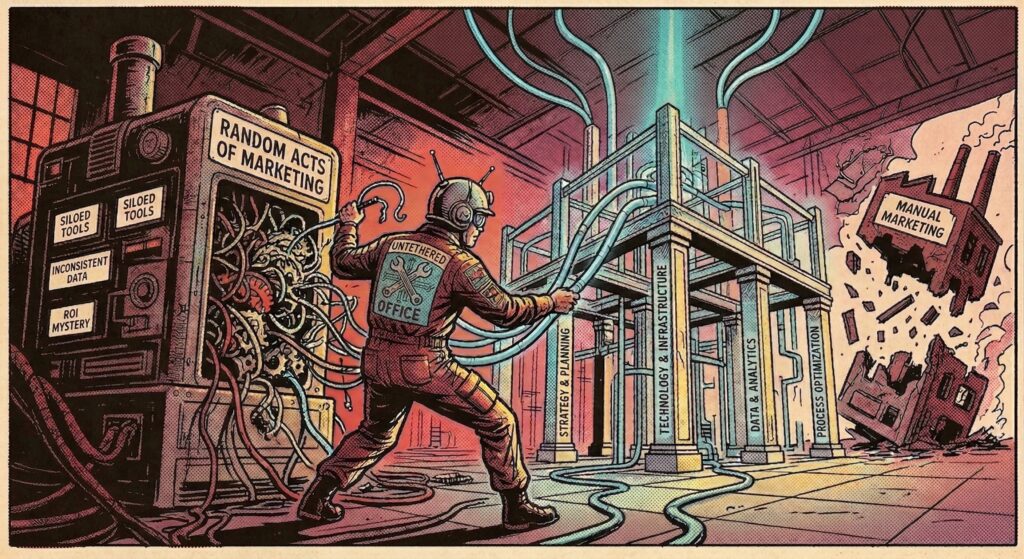
The Backbone of Modern Growth
In 2026, marketing is no longer just about creative campaigns; it is a game of precision, data integrity, and architectural excellence. The Modern Marketing Operations (MOps) Framework has evolved from a back-office support function into the strategic engine that powers B2B growth. This guide explores the four critical pillars of MOps: Strategy & Planning, Technology & Infrastructure, Data & Analytics, and Process Optimization. By implementing a robust MOps framework, organizations can bridge the gap between high-level strategy and technical execution, ensuring that every dollar spent is measurable and every lead is managed with surgical precision. Key takeaways include the necessity of a unified RevOps approach, the shift toward proactive data governance, and the strategic decision-making process between in-house talent and specialized agencies.
Why the Marketing Operations Framework Matters
The landscape of B2B marketing has undergone a seismic shift. As we navigate 2026, the complexity of the “martech stack,” the tightening of global data privacy regulations, and the demand for hyper-personalized customer journeys have made manual marketing impossible. Enter Marketing Operations—the “central nervous system” of the modern marketing department.
Marketing Operations is the function responsible for end-to-back marketing optimization, ranging from strategic planning and budget management to execution and analysis. Without a formal framework, marketing departments often suffer from “random acts of marketing,” where tools are purchased in silos, data is inconsistent, and ROI remains a mystery. A standardized MOps framework provides the blueprint for scalability, allowing companies to increase their output without a linear increase in headcount or cost. For organizations looking to dominate their sector, mastering this framework isn’t just an advantage; it’s a requirement for survival.
Defining the Modern MOps Ecosystem
Before diving into the mechanics, we must define the core pillars that sustain the Modern Marketing Operations Framework.
- Marketing Operations (MOps): The discipline of managing and optimizing marketing processes, people, and technology to increase efficiency and drive revenue.
- The Tech Stack: The collection of software (CRM, MAP, CMS, etc.) used by marketing teams to execute and measure their activities.
- Revenue Operations (RevOps): The alignment of sales, marketing, and customer success operations across the entire tech stack and go-to-market process.
- Data Governance: The set of rules and processes that ensure data is accurate, accessible, and compliant with legal standards.
- Lead Management: The architectural flow of a prospect from the first touchpoint to a closed-won deal.
While many confuse the tools with the discipline, it is vital to understand the nuances. For a deeper look at these distinctions, explore our guide on
Marketing Operations vs. Marketing Automation: What is the difference?.
1. Strategy and Planning: Aligning Vision with Execution
The first pillar of the framework is Strategy and Planning. In many organizations, there is a disconnect between the CMO’s vision and the actual capabilities of the marketing team. MOps acts as the translator.
Strategic MOps involves annual and quarterly planning where goals are mapped to technical requirements. This includes budget allocation, resource management, and setting the “North Star” metrics for the year. By 2026, top-tier MOps teams are using advanced project management methodologies to ensure agility. Choosing the right workflow is critical; for more information, see our analysis on
Which project management methodology is best for marketing operations teams?.
2. Technology and Infrastructure: Building a Scalable Stack
The modern martech stack is no longer a collection of “cool tools”; it is a sophisticated ecosystem that must be integrated seamlessly. The MOps framework dictates how these tools talk to one another.
A mid-sized B2B company in 2026 typically manages between 20 and 50 different SaaS applications. If these tools aren’t integrated, you end up with “data islands” where information is trapped. The framework ensures that the CRM (Customer Relationship Management) serves as the single source of truth, while the Marketing Automation Platform (MAP) handles the heavy lifting of communication. Selecting the right tools is the foundation of this pillar. Discover our recommendations in
What are the best marketing operations tools for a mid-sized B2B company in 2024?.
3. Data Governance and Privacy: The New Gold Standard
In 2026, data is your most valuable asset, but it is also your greatest liability. With the proliferation of AI-driven marketing, the quality of your output is entirely dependent on the quality of your data.
The MOps framework must include a rigorous data governance strategy. This involves defining how data enters the system, how it is cleaned, and how it is stored. Furthermore, with evolving legal landscapes, compliance is non-negotiable. MOps teams must be experts in regulatory requirements. For a step-by-step walkthrough, refer to our guides on
How do you build a marketing data governance framework from scratch? and
How to ensure marketing operations compliance with US data privacy laws?.
4. Process Optimization: The Engine of Efficiency
Process optimization is where the “Operations” in MOps truly shines. This involves documenting and refining every workflow, from how a webinar is launched to how a lead is passed to sales.
One of the most common friction points in B2B growth is lead routing. When a lead gets stuck in the system or assigned to the wrong rep, the “speed to lead” is destroyed, and revenue is lost. A core component of the MOps framework is identifying and fixing these leaks. If you’re experiencing friction, read our deep dive:
Why is my lead routing failing and how can marketing operations fix it?.
5. Measurement and ROI: Proving Marketing’s Value
The ultimate goal of the MOps framework is to turn the marketing department from a cost center into a profit center. This requires sophisticated attribution modeling and a deep understanding of unit economics.
MOps professionals must be able to report on more than just “clicks” and “opens.” They must demonstrate how marketing activities impact the bottom line. This involves calculating the lifetime value (LTV) of a customer and understanding how operational efficiency lowers the cost of acquisition. To master these metrics, see our resources on
How to calculate the ROI of investing in marketing operations? and
What is the impact of marketing operations on customer acquisition costs (CAC)?.
Practical Applications and Use Cases
How does the Modern MOps Framework look in the real world? Consider these scenarios:
Common Challenges and Solutions
Even with a framework, challenges arise. Common hurdles include:
- Technical Debt: Old tools and messy code slowing down the system. Solution: Regular “stack audits” and a strict “one-in, one-out” tool policy.
- Skill Gaps: The difficulty of finding talent who understands both marketing strategy and database architecture. This leads to a critical decision: Is it worth hiring a marketing operations agency or should I hire an in-house manager?.
- Siloed Data: Departments not sharing information. Solution: Implementing a centralized data warehouse and a RevOps mindset.
| Challenge |
Impact |
Framework Solution |
| Poor Data Quality |
Inaccurate Reporting |
Data Governance Framework |
| Lead Leakage |
Lost Revenue |
Automated Lead Routing & Alerting |
| Tool Overlap |
Wasted Budget |
Tech Stack Audit & Consolidation |
| Sales/Marketing Friction |
Low Conversion |
Unified RevOps Strategy |
Best Practices and Recommendations for 2026
To truly excel in Marketing Operations, Untethered Office recommends the following:
- Adopt an “API-First” Mentality: Only purchase tools that offer robust, open APIs to ensure future-proof integrations.
- Prioritize Documentation: Every process, from lead scoring to campaign naming conventions, must be documented in a central wiki.
- Focus on the “Customer Journey,” Not Just the “Lead”: MOps should oversee the entire lifecycle, including post-sale expansion and retention.
- Invest in Continuous Education: The MOps landscape changes monthly. Ensure your team (or your agency) is staying ahead of AI and privacy trends.
Summary and Next Steps
The Modern Marketing Operations Framework is the essential blueprint for any B2B organization looking to scale efficiently in 2026. By focusing on strategy, technology, data, and process, you create a resilient engine that drives predictable revenue.
Next Steps:
- Audit your current stack: Identify redundant tools and data silos.
- Define your governance: Establish who owns data entry and cleanup.
- Evaluate your talent: Determine if you need an in-house lead or a specialized agency like Untethered Office to accelerate your growth.
- Align with Sales: Move toward a RevOps model to ensure your MOps efforts are directly supporting revenue goals.
For more expert insights and to build your custom MOps roadmap, contact the team at Untethered Office today.
Explore This Topic
Dive deeper into specific aspects of this topic with our detailed guides:
Frequently Asked Questions
What is a Marketing Operations Framework?
A Marketing Operations Framework is a structured approach to managing the people, processes, and technology that power a marketing department. It covers everything from lead management and tech stack integration to data governance and ROI reporting.
What is the difference between Marketing Operations and Marketing Automation?
Marketing Operations (MOps) focuses on the overall strategy, infrastructure, and process optimization of marketing. Marketing Automation is a subset of MOps that specifically refers to the software used to automate repetitive tasks like emails and social media posts.
How does MOps differ from RevOps?
While MOps focuses specifically on the marketing funnel, RevOps (Revenue Operations) aligns marketing, sales, and customer success operations into a single unified function to optimize the entire revenue lifecycle.
When should a company invest in a formal MOps function?
Common signs include inaccurate reporting, lead leakage (leads not being followed up on), high martech spend with low utilization, and constant friction between your sales and marketing teams.
Is it better to hire a MOps agency or an in-house manager?
For startups or mid-sized companies, an agency often provides a broader range of expertise for the cost of one full-time hire. Larger enterprises with complex, high-volume needs may benefit more from a dedicated in-house team.
How does Marketing Operations impact Customer Acquisition Cost (CAC)?
MOps improves CAC by optimizing lead routing (reducing waste), improving lead scoring (increasing sales efficiency), and providing the data needed to stop spending on underperforming channels.
What are the essential tools for a modern MOps stack?
A standard stack includes a CRM (like Salesforce), a Marketing Automation Platform (like HubSpot or Marketo), a data enrichment tool, an attribution platform, and a project management tool.
Why is data governance important in Marketing Operations?
Data governance ensures that your marketing data is clean, compliant with laws like GDPR/CCPA, and structured correctly for AI and reporting tools to use effectively.
How do you measure the success of a MOps team?
Success is measured through metrics like lead-to-opportunity conversion rates, marketing-sourced revenue, tech stack ROI, and the ‘speed to lead’ (how fast sales contacts a prospect).
What is fractional marketing operations?
Fractional MOps allows companies to access high-level strategic expertise and technical implementation on a part-time or project basis, making it ideal for startups that need to scale but aren’t ready for a full-time executive hire.