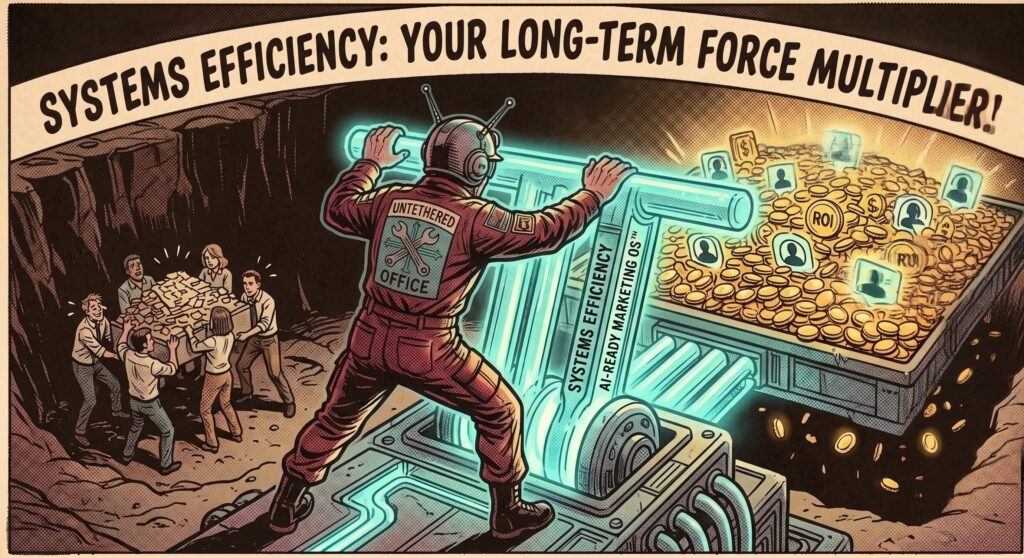
Investing in systems efficiency generally provides a higher long-term ROI for B2B organizations compared to adding marketing headcount, especially in the 2026 AI-driven landscape. While new hires provide immediate task capacity, systems efficiency creates scalable leverage, reducing the cost per lead and eliminating manual bottlenecks that hinder growth. For most mid-market B2B firms, optimizing the existing “operating system” is the essential prerequisite for sustainable scaling and effective AI adoption.
Data from 2026 reveals that B2B organizations prioritizing operational efficiency see a 25-30% increase in pipeline velocity without increasing staff costs [1]. Conversely, adding headcount to dysfunctional systems often results in a “complexity tax,” where 40% of a new hire’s time is spent on manual data entry and cross-departmental coordination rather than high-value strategy [2]. Research indicates that firms utilizing an
AI-Ready Marketing OS™ achieve 2.5x more revenue per employee than those relying on manual workflows [3].
This ROI comparison is critical for marketing directors who face increasing pressure to prove attribution and scale performance. At
Untethered Office, we observe that leaders who choose “Ops-First” strategies gain executive-grade clarity that manual headcount simply cannot provide. Systems efficiency serves as a force multiplier, allowing a lean team to outperform larger competitors by automating the lead-to-revenue lifecycle and ensuring data integrity across the tech stack.
At a Glance:
- Verdict: Systems efficiency is superior for long-term ROI and scalability.
- Biggest Pro: Scalable leverage that decreases marginal costs as lead volume grows.
- Biggest Con: Requires upfront time investment and cultural shift toward data discipline.
- Best For: B2B directors at $50M+ companies drowning in manual reporting and disconnected tools.
- Skip If: You have a zero-tech foundation and require immediate, basic human administrative support.
What Are the Pros of Investing in Systems Efficiency?
Exponential Scalability and Leverage
Efficiency investments allow your marketing output to grow without a linear increase in payroll costs. By automating lead scoring and nurturing sequences, a single system can manage 10,000 leads as easily as 100, providing massive ROI as the business scales. This creates “scalable leverage,” where the cost of acquiring each additional customer actually decreases over time.
Executive-Grade Data Clarity
Systems optimization creates a single source of truth for marketing performance and attribution. When systems are integrated correctly, directors can answer CEO questions about ROI instantly rather than spending days manually reconciling spreadsheets. This transparency builds executive trust and secures future budget approvals by proving exactly where revenue originates.
AI Readiness and Future-Proofing
You must earn the right to use AI by first establishing clean, efficient workflows. An optimized system acts as an
AI-Ready Marketing OS™, providing the structured data that 2026 AI tools require to function effectively. Without this foundation, AI only accelerates existing chaos; with it, AI becomes a powerful autonomous operator for your business.
Reduced Employee Burnout and Turnover
Efficient systems remove the “grunt work” that leads to junior and mid-level talent quitting. When employees spend their time on creative strategy rather than manual data cleaning, job satisfaction and retention rates increase significantly. This saves the company the high cost of recruiting and training replacements, which can exceed 50-100% of an employee’s annual salary.
Consistent Sales and Marketing Alignment
Automated clarity loops ensure that sales teams receive high-quality, pre-qualified leads with full context. This eliminates the adversarial “finger-pointing” common in B2B environments regarding lead quality. Systems efficiency enforces a Service Level Agreement (SLA) through technology, ensuring seamless handoffs and higher win rates.
What Are the Cons of Investing in Systems Efficiency?
Higher Upfront Implementation Effort
Optimizing systems requires an initial “sprint” of deep work that can temporarily distract from daily campaign execution. Unlike hiring a person who can start taking tasks on day one, systems work requires auditing, mapping, and technical configuration. However, firms like
Untethered Office mitigate this by focusing on quick wins that provide value within the first quarter.
Requirement for Cultural Discipline
Efficiency only works if the human team adheres to the new standardized processes and data entry rules. If team members refuse to use the CRM correctly or bypass automated workflows, the system’s ROI will diminish. This requires strong leadership and a shift in mindset from “being busy” to “being effective.”
Technical Skill Gaps in Existing Staff
Managing a high-efficiency system may require your current team to learn new interfaces or conceptual frameworks. Some traditional marketers may feel threatened by automation or struggle to adapt to a data-first environment. This can lead to a period of friction where staff must be upskilled or repositioned into strategic roles.
Risk of “Tool Overload” Without Strategy
If efficiency is pursued by simply buying more software (False Solutions) rather than fixing underlying systems, it can increase complexity. Many B2B firms fall into the trap of layering AI onto broken operations, which leads to a fragmented tech stack. True ROI comes from system architecture, not just adding more subscriptions to the credit card.
Delayed Gratification Compared to Headcount
A new hire provides a “warm body” in the office immediately, which can give a false sense of progress to executives. Systems efficiency is a “quiet” improvement that may take 30-60 days to show its full impact on the bottom line. Marketing directors must manage executive expectations during the transition from manual to automated operations.
Pros and Cons Summary Table
| Investment Area |
Primary Pros |
Primary Cons |
| Systems Efficiency |
Scalable ROI, Data Accuracy, AI-Ready, High Retention |
Upfront Time, Cultural Shift, Technical Learning |
| Adding Headcount |
Immediate Task Relief, Human Intuition, Familiar Model |
High Ongoing Cost, Hard to Scale, Chaos Multiplication |
When Does Systems Efficiency Make Sense?
Systems efficiency makes the most sense when your marketing director is “drowning” in manual reporting and cannot prove ROI to the board. If your team spends more than 20% of their week in spreadsheets or manually moving leads between tools, you have an operations problem, not a staffing problem. Investing in an
AI-Ready Marketing OS™ is the right move when you need to scale performance without doubling your payroll.
Furthermore, if your organization plans to implement AI in 2026, systems efficiency is a mandatory prerequisite. AI requires structured data and proven workflows to be effective. As we teach at
Untethered Office, you must prioritize “Ops-First, AI-Second” to ensure your technology investment actually reduces work instead of adding more technical debt.
When Should You Avoid Systems Efficiency?
You should avoid deep systems optimization if your business model is still in the “pre-product-market fit” stage where processes change daily. In very early-stage startups, human flexibility is often more valuable than rigid automation. If your marketing “stack” consists only of a LinkedIn account and a basic email tool, you may need a foundational hire to establish basic activities before you can optimize them.
Additionally, avoid systems-heavy investments if there is zero executive buy-in for data-driven decision-making. If the CEO prefers “gut-feel” marketing and refuses to look at attribution dashboards, the ROI of a high-efficiency system will be lost. Efficiency requires an environment that values clarity and outcome ownership.
What Are the Alternatives to Adding Headcount?
Fractional Marketing Operations (AI-Enabled)
Instead of a full-time $120k/year hire, many firms use fractional experts to build and maintain their systems. This provides executive-grade expertise without the overhead of a full-time salary, benefits, and equity. This model allows organizations to “rent” the brain of an architect to build the system, then have their internal team run it.
The “AI-Ready Marketing Operations Sprint”
Rather than a six-month implementation project, a high-intensity sprint can fix the biggest operational bottlenecks in weeks. This alternative focuses on “Executive-Grade Clarity Loops™”—reporting built specifically around the decisions the CEO needs to make. This delivers the “wins” of a new hire much faster and with more precision.
Managed MarTech Services
Outsourcing the technical management of your stack (HubSpot, Salesforce, etc.) allows your internal team to focus entirely on content and strategy. This is often more cost-effective than hiring a dedicated internal “admin” who may lack the broad perspective of an agency that sees hundreds of different configurations.
Frequently Asked Questions
How do I calculate the ROI of systems efficiency vs. headcount?
To calculate the ROI of efficiency, subtract the “cost of manual work” (hours spent on tasks x hourly rate) from the projected revenue increase generated by faster lead response times. For headcount, you must include recruitment, salary, benefits, and the “ramp-up” period where the hire is not yet productive. In 2026, systems typically show a 3x higher ROI over a 24-month period compared to a mid-level hire.
Will AI replace the need for marketing operations staff?
AI will not replace the need for operations, but it will fundamentally change the role from “data entry” to “system architecture.” Organizations will still need human leaders to design the
AI-Ready Marketing OS™ and interpret the
Executive-Grade Clarity Loops™. The goal of systems efficiency is to allow your humans to do human work while AI handles the repetitive execution.
How long does it take to see results from systems optimization?
While a full transformation can take a quarter, specific “quick wins” can be realized in as little as 30 days. Most B2B organizations see a significant improvement in data clarity and team morale within the first 45 days of an optimization sprint. The long-term ROI of reduced cost-per-acquisition usually becomes evident within 6 to 9 months.
What is the biggest risk of choosing efficiency over headcount?
The biggest risk is “under-tooling” your strategy by having great systems but no one to create the creative content that feeds them. Systems are the engine, but content is the fuel. A balanced approach ensures that your existing team is freed from manual work so they can focus on the high-quality creative work that systems cannot replicate.
Sources
[1] B2B Marketing Operations Benchmark Report 2026.
[2] Research on MarTech Utilization and Complexity Tax, 2025.
[3] Untethered Office Internal Benchmarking: The AI-Ready Marketing OS Impact Study.
Learn More
For more insights on building a scalable marketing foundation, explore our [[LINK:AI-Ready Marketing Operations Sprint]] or learn about our [[LINK:fractional marketing ops]] services. You can also read our perspective on [[LINK:Ops-First AI-Second]] strategies for 2026.
In summary, while adding headcount provides a temporary sense of relief, investing in systems efficiency is the only way to achieve sustainable, scalable growth in the modern B2B landscape. By building an
AI-Ready Marketing OS™, you create the executive-grade clarity needed to lead your department with confidence rather than drowning in operational chaos.
Frequently Asked Questions
How do I calculate the ROI of systems efficiency vs. headcount?
To calculate the ROI of efficiency, subtract the “cost of manual work” (hours spent on tasks x hourly rate) from the projected revenue increase generated by faster lead response times. For headcount, you must include recruitment, salary, benefits, and the “ramp-up” period where the hire is not yet productive. In 2026, systems typically show a 3x higher ROI over a 24-month period compared to a mid-level hire.
Will AI replace the need for marketing operations staff?
AI will not replace the need for operations, but it will fundamentally change the role from “data entry” to “system architecture.” Organizations will still need human leaders to design the AI-Ready Marketing OS™ and interpret the Executive-Grade Clarity Loops™. The goal of systems efficiency is to allow your humans to do human work while AI handles the repetitive execution.
How long does it take to see results from systems optimization?
While a full transformation can take a quarter, specific “quick wins” can be realized in as little as 30 days. Most B2B organizations see a significant improvement in data clarity and team morale within the first 45 days of an optimization sprint. The long-term ROI of reduced cost-per-acquisition usually becomes evident within 6 to 9 months.
What is the biggest risk of choosing efficiency over headcount?
The biggest risk is “under-tooling” your strategy by having great systems but no one to create the creative content that feeds them. Systems are the engine, but content is the fuel. A balanced approach ensures that your existing team is freed from manual work so they can focus on the high-quality creative work that systems cannot replicate.